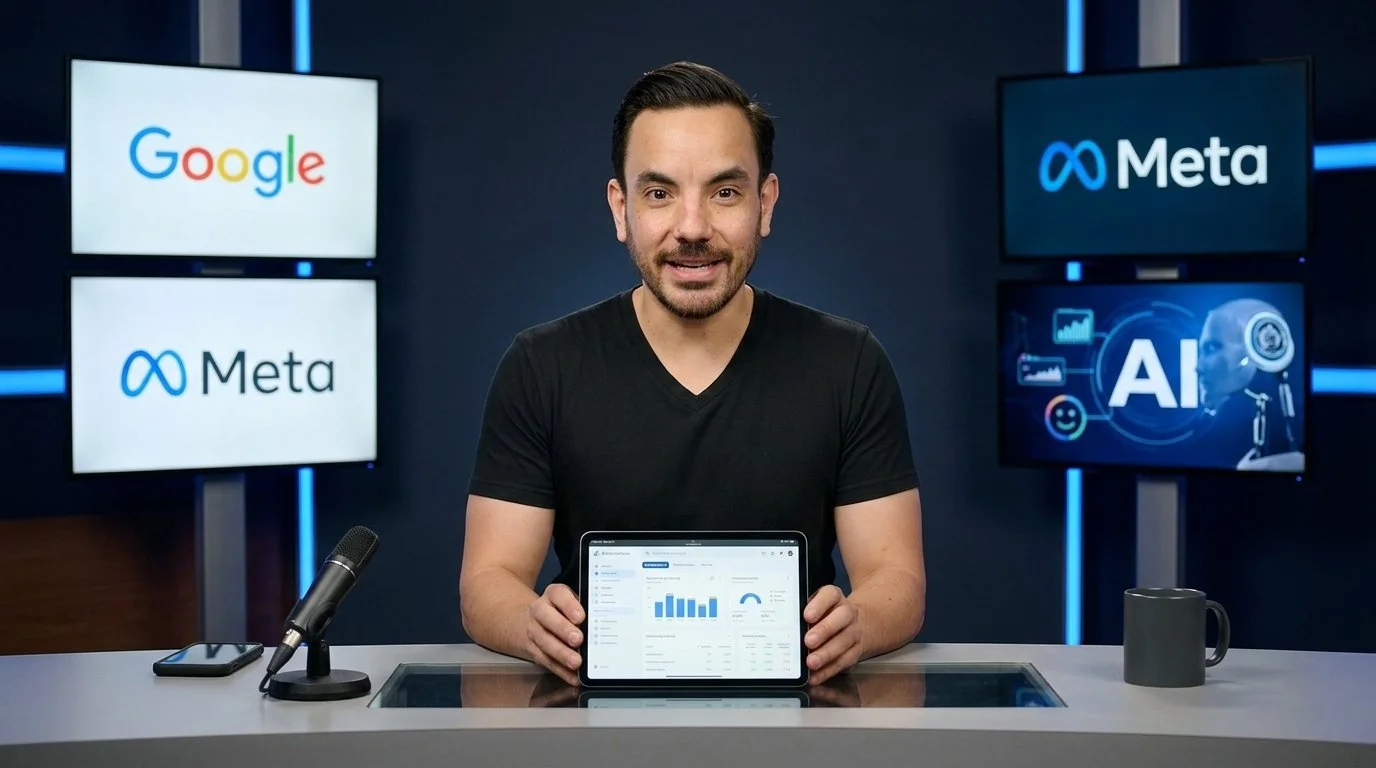
Welcome to the May 2026 roundup. Five stories this month that I think every ecommerce advertiser needs to know about, ranging from Google quietly slipping ads into AI Mode, to Meta's AI tools modifying your creative without permission. Let me run through them all.
Google AI Mode Now Has Ads
This one flew under the radar for most advertisers, but it is a big deal.
Google is testing two new ad formats inside AI Mode: Sponsored Stores and Direct Offers. Sponsored Stores appear inside AI Mode product detail panels, while Direct Offers let advertisers embed discounts directly into AI-generated responses.
Here is the critical part: these placements work through your existing Shopping and Performance Max campaigns. There is no new campaign type you need to create. If you are already running Shopping or PMax, you may already be appearing in these placements without realising it.
What determines whether you win placement? It is not bid levels. Google is prioritising clean product feeds and strong structured data quality. This means your feed hygiene, your product titles, your descriptions, your attributes, and your structured data markup are what matter most for visibility in AI Mode.
Separately, Google also announced AI Max is now expanding to Standard Shopping campaigns, extending your reach into conversational, open-ended queries that traditional Shopping campaigns would never have matched against.
What to do now
Audit your product feed. Make sure your titles are descriptive and keyword-rich, your product attributes are fully populated, and your structured data markup is clean. This is the single biggest lever you have for winning AI Mode placements.
Meta's AI Tools Are Modifying Your Ad Creative Without Permission
This story made me genuinely uncomfortable.
Multiple advertisers are reporting that Meta's AI tools are making unauthorised modifications to their ad creative. The most notable case involves Snag Tights, where AI-generated tweaks actually distorted their product images. Meta is also adding unexpected AI testing budgets to campaigns without explicit advertiser consent.
On top of this, Meta's Andromeda ad retrieval system overhaul is changing the underlying mechanics of how ads are matched to users. And separately, Meta's Manus AI agent is showing up inside Ads Manager with the capability to manage campaign decisions autonomously.
The broader pattern here is clear: Meta is pushing automation aggressively, and it is coming at the expense of advertiser oversight and control.
What to do now
Go into your Meta Ads Manager and review your active ads for any unexpected creative variations. Check whether any AI-generated budget allocations have appeared that you did not approve. If you spot anything odd, document it and report it through the proper channels. I would also recommend checking your ad previews regularly rather than assuming what you uploaded is what is running.
AI Traffic to Retailers Up 393%
Adobe data shows that AI-driven traffic to US retailers increased 393% year-on-year in Q1 2026. That number alone is striking, but the quality of this traffic is what makes it really interesting.
AI visitors spend 48% longer on site, browse 13% more pages, and generate 37% more revenue per visit compared to traffic from other sources. This is not junk traffic; it is high-intent, high-value traffic.
Shopify Agentic Storefronts activated by default for eligible US merchants on 24 March 2026, feeding product data directly into ChatGPT recommendations. Amazon Rufus is doing something similar on the Amazon side. And Google AI Mode, as I covered above, is now showing Shopping ads directly in conversational results.
Here is the catch: having strong organic rankings or even 4.8-star reviews does not guarantee visibility in AI recommendations. AI evaluates product data quality independently. Your products might be completely invisible to AI-driven shopping despite performing well in traditional search.
What to do now
Open your Google Analytics and look for AI referral traffic. Compare its conversion quality against your other traffic sources. Then review your product data across all platforms, because the signals that drive AI recommendations are different from the signals that drive traditional SEO or paid search performance.
DSA Is Going Away in September
Google has officially confirmed that Dynamic Search Ads will transition to AI Max for Search campaigns, with Google beginning auto-upgrades in September 2026.
Starting from 15 April, new tools have been made available to help advertisers transfer DSA settings and data into standard ad groups. The transition roadmap gives you several months to migrate on your own terms before Google forces the change.
Important distinction: AI Max for Search is not Performance Max. It keeps you in the Search channel while layering in AI-driven query expansion. Think of it as DSA's replacement that uses AI to match against a broader range of conversational and open-ended queries, but without the black-box, multi-channel nature of PMax.
What to do now
If you are running DSA campaigns, start your migration now. Use the new transfer tools Google has provided to move your DSA settings into standard ad groups. Do not wait until September when Google will auto-upgrade you, because forced migrations rarely go smoothly, and you lose control over how your campaigns are restructured.
Meta Projected to Surpass Google in Ad Revenue for the First Time
This is a historic shift in the advertising industry.
eMarketer projects that Meta will surpass Google in global advertising revenue for the first time ever in 2026. The numbers: Meta is forecast at $243.46 billion versus Google's $239.54 billion. Meta is growing at 24.1% year-on-year compared to Google's 11.9%.
Where is this growth coming from? Instagram Reels now accounts for 33% of all Instagram ad impressions. Meta's Reels ad product is running at a $50 billion annual rate, and Advantage+ sits at a $60 billion annual run rate. The Reels and AI-powered automation products are driving enormous revenue.
On the Google side, Alphabet's Q1 2026 earnings confirmed Search revenue up 19% and YouTube up 11%, but both came in below analyst targets.
What this means for your strategy
The revenue inversion validates something many advertisers have felt for the past year: Meta's advertising products are genuinely performing, and the platform is earning its growth through results rather than just market position. If you have been hesitant about increasing Meta spend or testing Reels placements, this macro data suggests the broader market has already made that move.
Conclusion
Five major developments this month that ecommerce advertisers need to act on:
Google AI Mode Ads are live through existing Shopping and PMax campaigns. Feed quality determines placement, not bids. Audit your product feed now.
Meta's AI creative modifications are happening without explicit advertiser consent. Check your Ads Manager for unexpected variations and budget allocations.
AI traffic to retailers grew 393% year-on-year with significantly higher conversion quality. Check your analytics for AI referral traffic and review your product data quality across platforms.
DSA is being sunset in September 2026 with auto-upgrades to AI Max for Search. Migrate on your own terms before Google forces the change.
Meta is projected to surpass Google in global ad revenue for the first time ever. The shift validates Meta's investment in Reels and Advantage+ automation, and is worth considering in your budget allocation decisions.

![[CASE STUDY] From $10K to $723K Monthly Revenue for Manta Sleep](https://images.squarespace-cdn.com/content/v1/5352434ee4b0aedbe40d16dd/1587016094478-BGJG6NC7K6KQN8H81JMW/62020860_2438306076387608_3911898948121395200_n.jpg)
![[CASE STUDY] 600% Increase in Revenue at 611% ROI for Elite Supplements](https://images.squarespace-cdn.com/content/v1/5352434ee4b0aedbe40d16dd/1524125532955-1UMZP1303RVFWUCI8PNJ/SupplementsFreeVectorIconPack3.png)