The Performance Max versus Standard Shopping debate has completely changed in 2026. If you made a decision about which campaign type to use a year or two ago, that decision might now be wrong.
I've been running Big Flare for over 13 years now, managing both campaign types across dozens of ecommerce accounts every single day. The reasons to pick one over the other have shifted dramatically, and a lot of the old arguments for choosing Standard Shopping over PMax are now completely obsolete.
It used to be simple.
Standard Shopping equalled control and precision.
Performance Max equalled automation and trusting the AI.
That gap has narrowed dramatically. Let me walk you through what's actually different now.
The Core Difference: Channel Coverage
Standard Shopping runs Shopping ads only. Full stop. Your ads show on Google Shopping and nowhere else.
Performance Max is multi-channel by design, with access to Shopping, Search, Display, YouTube, Gmail, and Discover. In practice for ecommerce, about 80% of your spend goes to Shopping ads, around 15% to Search text ads, and roughly 5% to retargeting through Display and YouTube. PMax gravitates towards retargeting for visual ad formats because that's what typically hits the ROAS targets.
Bid Strategy Options: Edge to PMax
Standard Shopping offers Manual CPC, Target ROAS, and Maximise Clicks. But critically, it lacks Maximise Conversions and Maximise Conversion Value.
Performance Max offers Maximise Conversions, Maximise Conversion Value, Target ROAS, and Target CPA. But it lacks Manual CPC.
Why does this matter?
Manual CPC is rarely the optimal choice anymore. If you have accurate conversion tracking and 30 or more conversions per month, Target ROAS almost always outperforms Manual CPC.
The more significant issue is Standard Shopping's lack of Maximise Conversions and Maximise Conversion Value. In my opinion, this hurts when you're launching new campaigns. With PMax, you can start with Maximise Conversions, let it gather data, then progress to Target ROAS once you have enough conversion history. This progression works especially well if your account already has lots of existing conversion data.
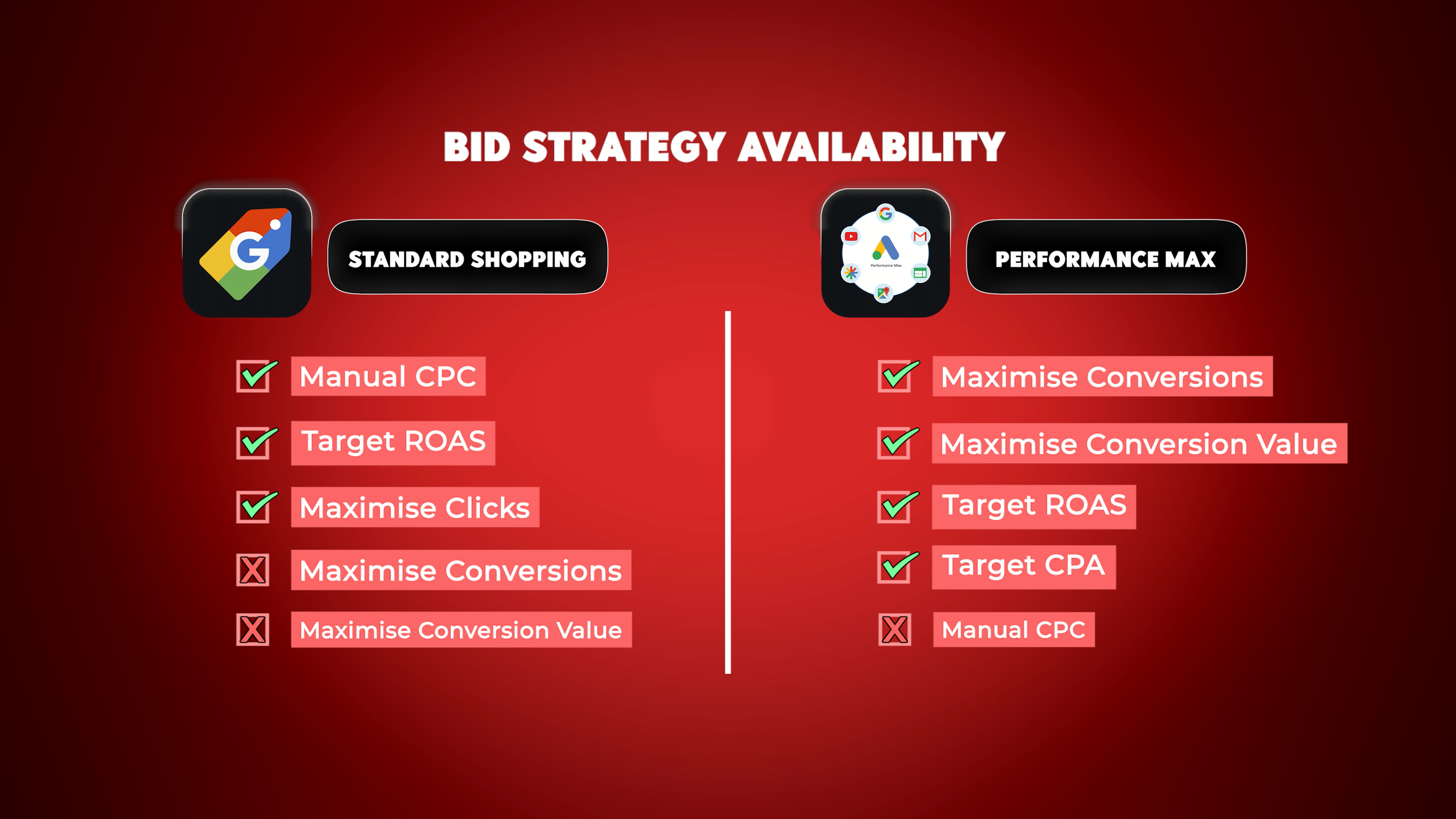
With Standard Shopping, you're stuck starting with either a very low Target ROAS or Maximise Clicks. Neither is ideal. The edge goes to Performance Max unless you absolutely require Manual CPC control, which is increasingly rare in 2026.
Search Terms Reporting: Now Equal
This is one of the areas where things have changed the most.
Standard Shopping has always had a full search terms report. Performance Max? When it launched in 2021, there was zero search terms reporting. A complete black box. Then in March 2023, Google introduced a Search Terms Insights Report, but it only showed category-based, auto-categorised terms that were difficult to browse and full of duplicates.
In 2024, Google finally rolled out a full proper search terms report for PMax. And in January 2025, another enhancement landed: you can now see whether queries come from keywordless targeting or from your search themes. The 2026 reality? PMax now has the same search terms visibility as Standard Shopping. They're equal.
Feed-Only PMax: No Longer Bulletproof
Feed-only PMax used to be the standard workaround: add your product feed, turn off auto asset creation, and skip all text, images, and videos. This was supposed to make PMax behave like a Shopping-only campaign.
The 2026 problem?
Feed-only PMax is becoming less reliable. I'm seeing clients where it ventures into YouTube, Search, and Display even without any assets. The effect is minimal if you're running Target ROAS with plenty of conversion data, you might see a few hundred dollars slip into non-Shopping channels. But if you're not running a ROAS target, the waste can be significant.
Bottom line: if you absolutely need 100% Shopping ads only, use Standard Shopping. That feed-only workaround is no longer bulletproof.
Volume Potential vs Risk
Performance Max has a clear advantage on potential volume. Say Shopping maxes out at $100,000 in revenue per month. With PMax, you might receive that same $100,000 from Shopping, plus an extra $30,000 from Search text ads, plus another $5,000 from retargeting. More channels equals more scale potential.
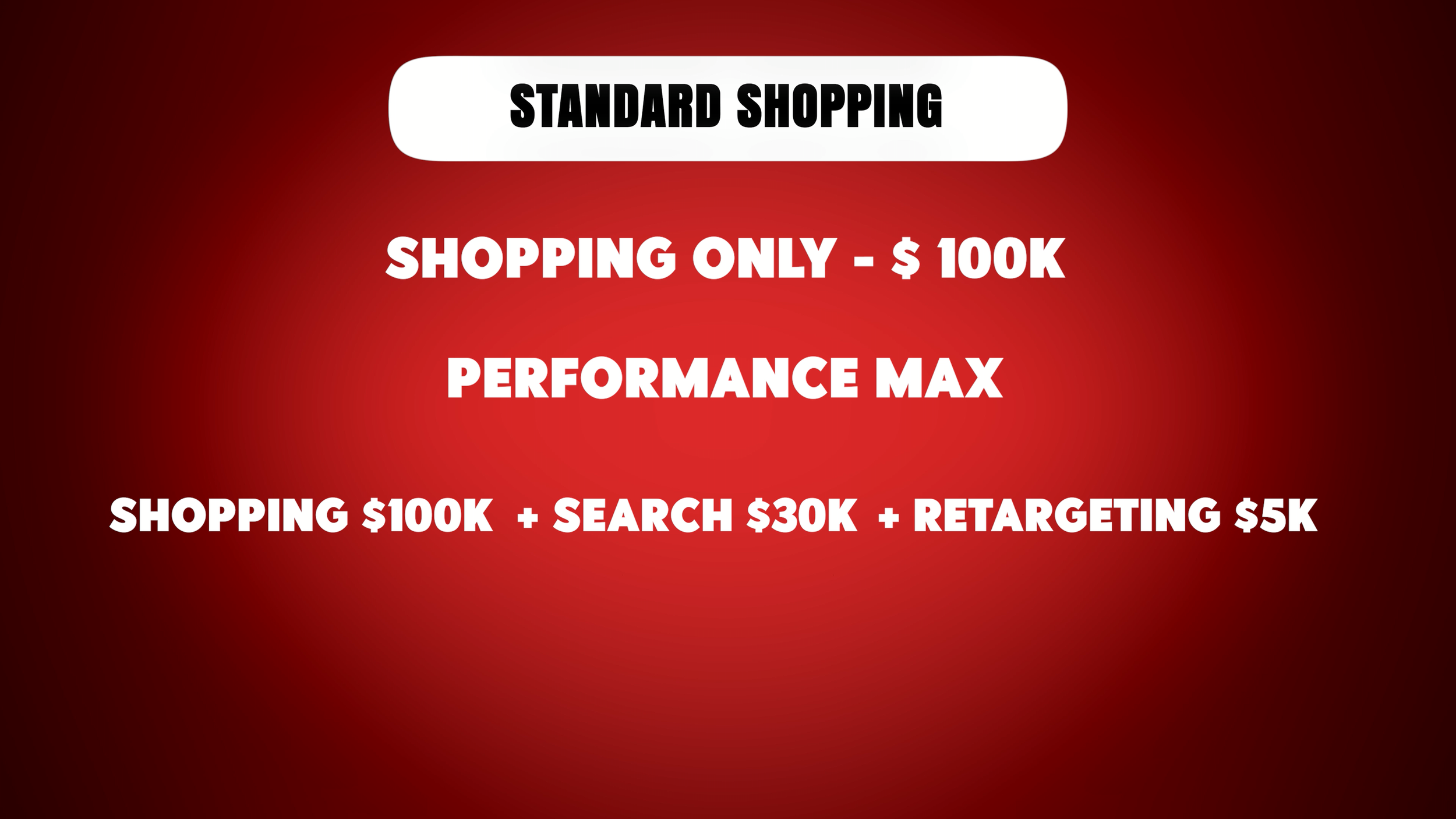
But PMax also carries higher risk. It has to test non-Shopping placements, which means higher risk of wasted spend during testing. Standard Shopping is lower risk, predictable, and controlled. Lower ceiling, but also a lower floor.
Negative Keywords: Gap Closed
With the 2024 and 2025 updates, PMax now has campaign-level negative keywords. This puts it almost on par with Standard Shopping for most use cases. Standard Shopping does still have ad group-level negatives for more granular traffic sculpting, but ad group-level negatives are rarely needed these days. Google has become very good at routing traffic appropriately. For most advertisers, campaign-level negatives in PMax are sufficient.
Brand vs Non-Brand Segmentation: Standard Shopping Wins
This is one area where Standard Shopping still has a meaningful advantage. You can use campaign priority settings to control brand versus non-brand traffic: create one campaign with brand terms negated (your non-brand campaign), then another without brand negatives (your brand campaign). Set the brand campaign to lower priority. Clean and reliable.
PMax lacks campaign priority settings entirely. The typical workaround is to use Standard Shopping for your brand campaign even if your main campaign is Performance Max. If you need clean brand versus non-brand segmentation, Standard Shopping makes it simpler.
How PMax Has Improved: A Summary
Many of the historical reasons to choose Standard Shopping are now obsolete. Here's what Performance Max gained in 2024 and 2025:
A full search terms report (actual search terms, not just category insights)
Channel performance reporting (see how much is spent on each channel)
Campaign-level negative keywords
Enhanced reporting showing whether queries came from keywordless targeting or search themes
PMax is no longer the "trust the algorithm" black box it was in 2021 and 2022. You now have visibility, control over negative keywords, and the ability to make informed decisions based on real data.
When to Choose Standard Shopping in 2026
Here are the scenarios where Standard Shopping is the right call:
You absolutely need Shopping ads only. Zero tolerance for spending on other channels. Do not trust the feed-only PMax workaround.
You require Manual CPC bidding. Though I'll say this is rarely optimal in 2026 if you have conversion tracking and volume.
You need granular brand vs non-brand segmentation. Campaign priorities make this cleaner than PMax alternatives.
You want the lowest-risk, most predictable option. No surprises, no testing on other channels. Lower ceiling but also lower floor.
You have limited conversion data or a new account with a smaller budget. When budget is tight, you want to concentrate spend on the best channel for ecommerce: Shopping ads.
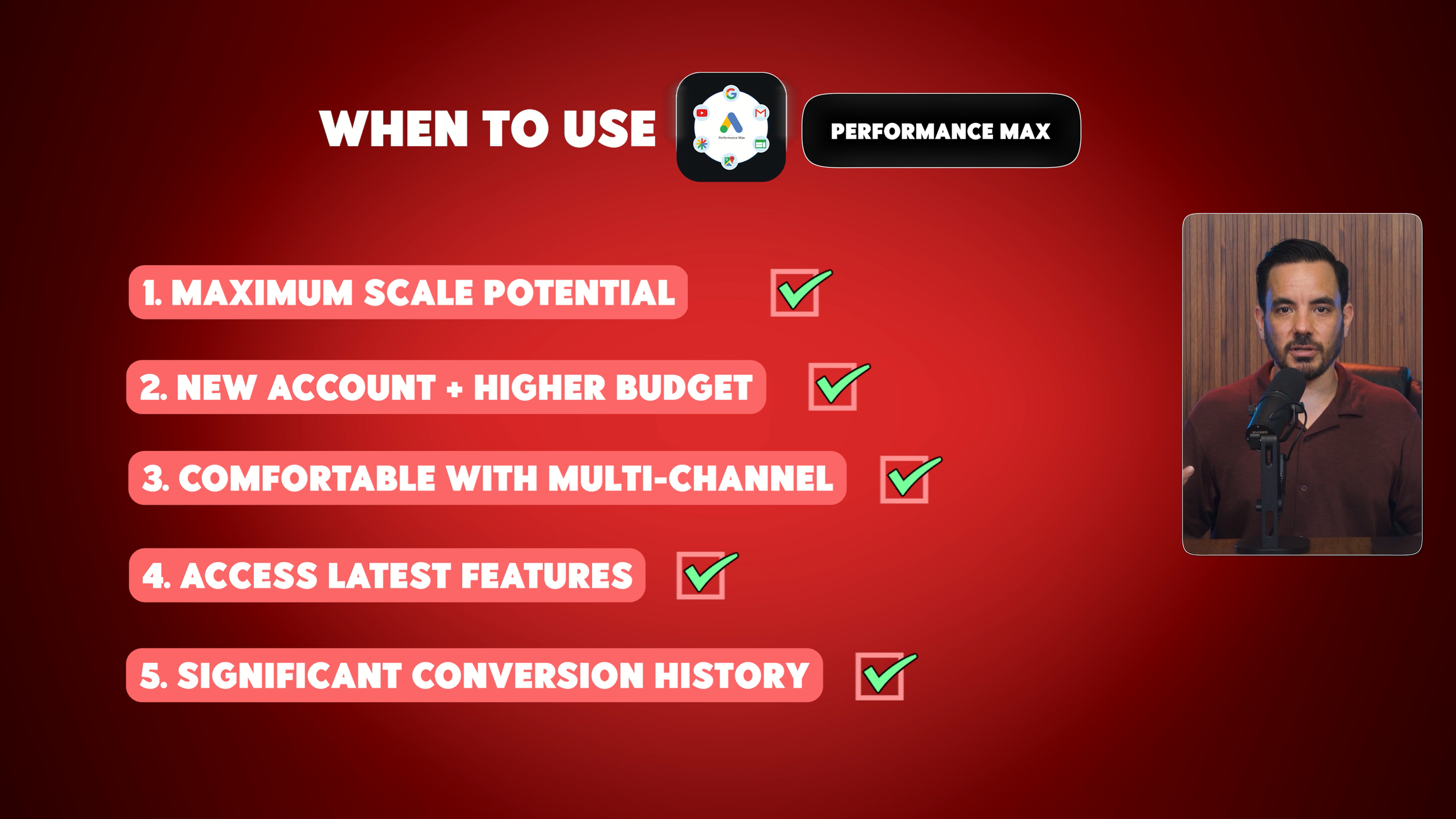
When to Choose Performance Max in 2026
And here are the scenarios where Performance Max is the better choice:
You want maximum scale and volume potential. Access to all Google channels means a higher ceiling for growth.
You have limited conversion data or a new account, but a higher budget. The Maximise Conversions to Target ROAS progression works well for cold starts.
You're comfortable with a multi-channel approach. You accept testing and optimisation across Shopping, Search, Display, and YouTube.
You want access to the latest Google features. PMax is clearly Google's priority. Standard Shopping is in maintenance mode.
You already have significant conversion history. With 100+ conversions in your account, PMax can leverage that data. Starter bid strategies like Maximise Conversions without a target use this existing data, giving you a better start than Standard Shopping's options.
Conclusion
The PMax versus Standard Shopping debate has fundamentally shifted in 2026. Many historical reasons to choose Standard Shopping, such as search terms visibility, the lack of negative keywords in PMax, and the black box narrative, are now obsolete thanks to PMax's 2024 and 2025 updates. However, Standard Shopping still holds meaningful advantages for Shopping-only focus, brand vs non-brand segmentation through campaign priorities, Manual CPC bidding, and lower-risk predictability. Choose Standard Shopping when you need control, predictability, or have a smaller budget. Choose Performance Max when you want maximum scale, have a higher budget, and are comfortable with multi-channel testing. Neither is universally "better"; the answer depends on your account's conversion history, budget, and growth objectives.