
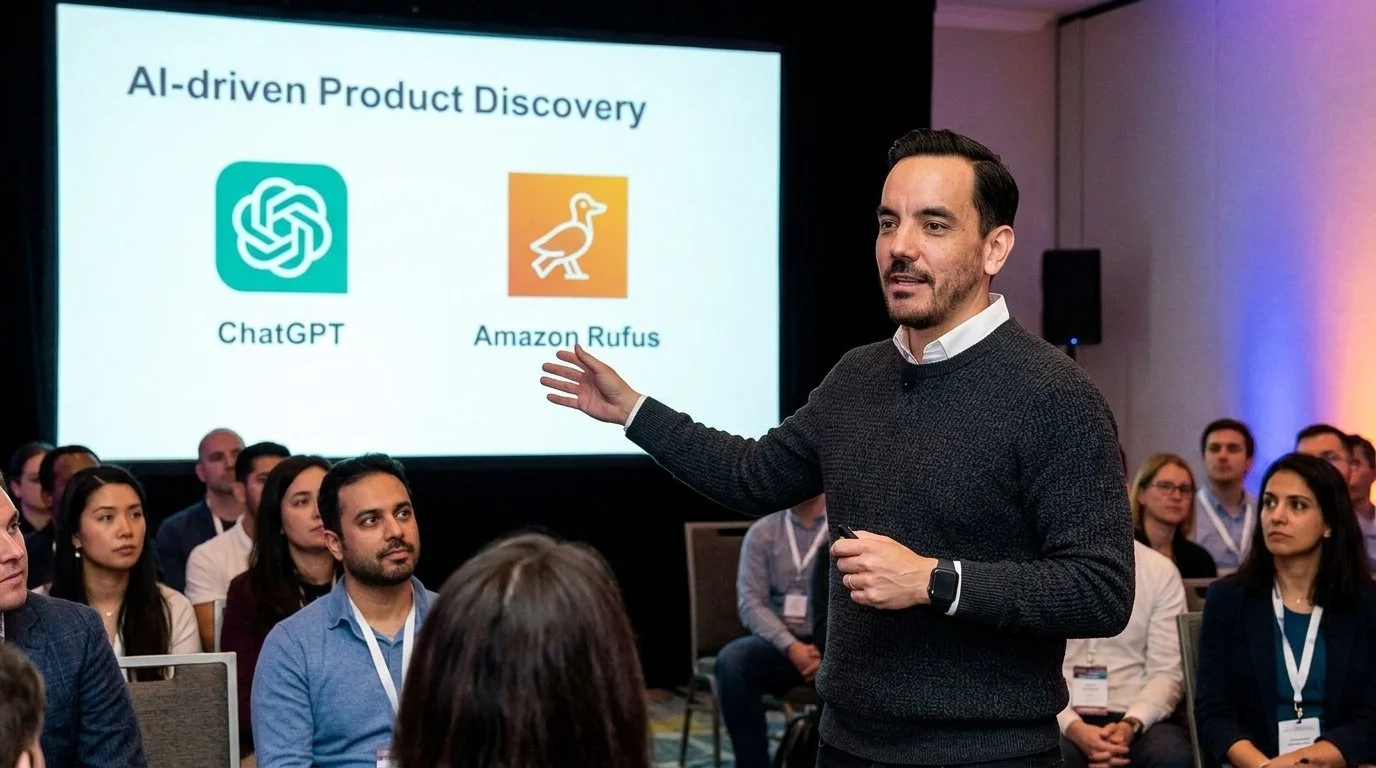
April has been a wild month across paid media and ecommerce, and I've been fielding panicked messages from clients asking what on earth is going on with their numbers. So rather than drip-feed the answers, I've pulled together the five stories every ecommerce advertiser needs on their radar this month.
Two narratives run through all of this. First, AI is becoming the front door for product discovery on every major platform. Second, platforms are quietly stripping signal and control away from advertisers. Let's start with the one that's probably already shown up in your dashboard.
Meta's Attribution Change Just Made Your CPA Look 50% Worse
On 8 April, Meta officially narrowed its click-through attribution definition to link clicks only. Likes, comments, shares, video plays and image expansions have all been pulled out of the attribution window and shoved into a new bucket Meta calls "engage-through attribution".
The impact inside Ads Manager has been brutal. There are accounts reporting 30 to 50 percent CPA spikes overnight, and the reflex from brands has been to slash budgets or pause campaigns entirely.
Here's the thing. This is a reporting change, not a performance change.
If you have a third-party attribution tool like Northbeam, Triple Whale or Polar running, pull it up right now and compare. The actual performance numbers haven't moved. Same sales, same revenue, same customers. Meta just changed what it chooses to count as a click.
What concerns me more than the reporting shock is the second-order effect. Meta's learning algorithm uses these same signals to decide who to target, and they've just been reclassified. Expect slower learning cycles and heavier reliance on modelled data over the next few weeks.
My advice for the next 30 days:
Before pausing anything, check your real source of truth: Shopify revenue, Amazon revenue, wherever your sales actually land. If real revenue is steady, your campaigns are fine
Cross-reference every performance call with a third-party tool, or at minimum UTM tracking into Google Analytics
Expect learning volatility and resist the urge to restructure campaigns reactively while Meta recalibrates
If you don't have any third-party attribution set up, now is the month to sort it
ChatGPT Is Now Recommending Your Products (And You Didn't Sign Up)
On 24 March, Shopify quietly enrolled millions of eligible US merchants into ChatGPT product discovery by default through its Agentic Storefronts feature. No opt-in. No email. If you're on Shopify and you're eligible, ChatGPT is already pulling your products into its shopping recommendations.
This is a fundamental shift, and it's the most underrated ecommerce story of the month.
AI discovery behaves nothing like paid media. There's no bid, no budget lever, no targeting to tweak. AI shopping assistants reward product data quality: accurate titles, specific descriptions, pricing, availability, reviews and trust signals decide which brands they surface.
The uncomfortable truth for most Shopify stores is that generic product descriptions that read like ad copy will not cut it. If your product page says "high-quality stainless steel water bottle, perfect for any lifestyle", you are invisible to an AI trying to answer "what's the best insulated water bottle for long hikes in hot climates?"
What I'd be doing this week:
Pick your top 10 best-sellers and ask: if someone typed "what's the best [product type] for [specific use case]" into ChatGPT, would your description help it confidently recommend you? If not, rewrite
Rewrite titles and descriptions to match how real customers phrase questions
Include use cases, dimensions, materials, compatibility, and edge-case details
Treat reviews and trust signals as discovery inputs, not just conversion aids
Do this even if you're not a US Shopify merchant — the same pattern is rolling out to other platforms and markets, and the brands that get ahead of it now will be 12 months in front of everyone else
Amazon Rufus Is Gatekeeping High-Intent Buyers
Staying on the AI discovery theme, Amazon's Rufus assistant has quietly transformed the platform from keyword search to problem-oriented shopping. And the data coming out of Amazon is striking: shoppers who interact with Rufus are 60 percent more likely to purchase.
That's the number that should make every Amazon seller sit up. Rufus is not just answering questions; it's routing the highest-intent buyers on Amazon toward a shortlist of brands.
The catch is that Rufus builds a confidence score for each brand before it decides whether to recommend you. That score is based on five things:
Order Defect Rate
Refund frequency
Customer message tone
Pricing consistency
Visual assets
If your listing has USPs buried inside lifestyle images, inconsistent pricing across variants, or sloppy A+ content, Rufus will skip right past you, no matter how well your PPC campaigns are performing.
My short audit checklist for Amazon clients this month:
Check your ODR and resolve any outstanding cases
Put your USPs, materials, and key specs in plain text, not just images
Align pricing across parent and child variants
Review customer messages for tone and response quality
Make sure A+ content is genuinely machine-legible
Google's Ad Strength Score Does Not Predict RSA Performance
This one is my favourite story of the month because it validates something many of us have been muttering under our breath for years.
Optmyzr analysed roughly 20,000 Google Ads accounts and found that Ad Strength, the metric Google actively prompts you to improve every time you write an RSA, does not reliably predict CPA or ROAS performance. Accounts with "Poor" Ad Strength ratings regularly outperformed accounts with "Excellent" ones, and vice versa.
Twenty thousand accounts is a serious sample size. This is not anecdotal. It's an independent, data-backed pushback on a metric Google itself has been heavily promoting inside the interface.
The practical implication is that you have permission to stop twisting your copy into a pretzel just to chase that "Excellent" label. Stop stuffing in 15 headlines that are minor variations of each other just to tick Google's boxes. Write copy that speaks to your actual customer, test it against performance data, and let Ad Strength sit in the corner being decorative.
What actually does correlate with better RSA performance, according to the study, is the relevance of your headlines to the actual search query, a clear offer in the description, a specific call to action, and genuine structural variation between headlines — not five rewordings of the same line so Google finally gives you a green bar. In other words: the fundamentals of good ad writing, not a dashboard score.
Your Merchant Center Feed Is Now Powering Half of Google
The final story comes straight from Google's own Ads Liaison, and it genuinely reframed how I think about the Merchant Center feed.
The feed is no longer just fuel for Shopping ads. It is now the underlying infrastructure for AI Mode conversational shopping, shoppable CTV, virtual try-ons, and a growing list of other Google surfaces. Poor feed quality no longer just hurts your Shopping ROAS; it quietly locks you out of exposure across an expanding range of high-value formats.
That is a huge shift in what "feed hygiene" means in 2026.
If you've been treating your feed as a set-and-forget piece of plumbing, now is the time to treat it as a frontline strategic asset. Block out an hour or two this month and run through Merchant Center properly:
Open the Diagnostics tab and clear any disapproved products, warnings, or missing attributes
Audit product titles — are they descriptive and keyword-rich, or still the manufacturer's default name?
Check your images — clean, high-resolution, and clearly showing the product, not cluttered with sale stickers or text overlays
Fill in the optional fields most stores skip: product type, GTINs, additional images, product highlights
A great feed lifts everything — Performance Max, Standard Shopping, AI Mode, the lot. A weak feed quietly caps all of it. Honestly, I'd put this above almost any campaign-level optimisation you could do this month, because it's the one change that earns your place on every new surface Google rolls out without you having to opt in.
Putting It All Together
Pulling back, the theme of April is this: the platforms are quietly reshaping both the signals they give us and the surfaces our products appear on, and most advertisers are operating on last year's mental model.
Meta is stripping attribution signal. ChatGPT and Rufus are becoming the new shopfront. Google's Ad Strength score is exposed as noise, while the Merchant Center feed is promoted to critical infrastructure.
The advertisers who are going to win through the back half of 2026 are the ones who invest in product data quality, third-party measurement, and fundamentally good copy, rather than chasing dashboard scores and in-platform metrics that no longer mean what they used to.
Pick one of these five to action this week. Momentum beats perfection.
One last thing. If the Merchant Center story got you thinking about your own feed, there's a really good chance that underwhelming Shopping ROAS you've been staring at is a feed problem, not a campaign problem. I've made a video that goes deep on exactly that — why low Shopping ROAS is almost always hiding in the feed, and what to do about it. I'll link it with this newsletter.
Conclusion
April 2026 delivered five shifts that every ecommerce advertiser needs to understand and act on:
Meta attribution change is inflating in-platform CPAs by 30 to 50 percent without changing real performance. Cross-reference with third-party tools before making budget decisions.
Shopify Agentic Storefronts have enrolled merchants into ChatGPT product discovery by default. Rewrite product descriptions for specificity and query-matchability.
Amazon Rufus is routing high-intent buyers (60 percent more likely to purchase) through a brand confidence score. Audit ODR, pricing consistency, visual assets, and listing clarity.
Optmyzr's 20,000-account study shows Google's Ad Strength does not predict RSA performance. Stop chasing the "Excellent" label and write copy that speaks to customers.
Google's Merchant Center feed is now infrastructure for AI Mode, CTV, and virtual try-ons. Treat feed quality as a strategic priority, not plumbing.
The common thread: product data quality and independent measurement are your biggest levers for the rest of 2026.