
I’ve been running Google Ads for ecommerce brands for almost two decades, and competitor targeting remains one of my favourite profit makers. Below I’m walking you through the exact playbook I use to hijack competitor demand and turn it into paid orders.
Why Competing For Competitor Traffic Works
People who search for your competitors are already warm. They know the category, they are actively in-market, and many are ready to buy. That is why you will often see rival brands bidding on each other’s names.
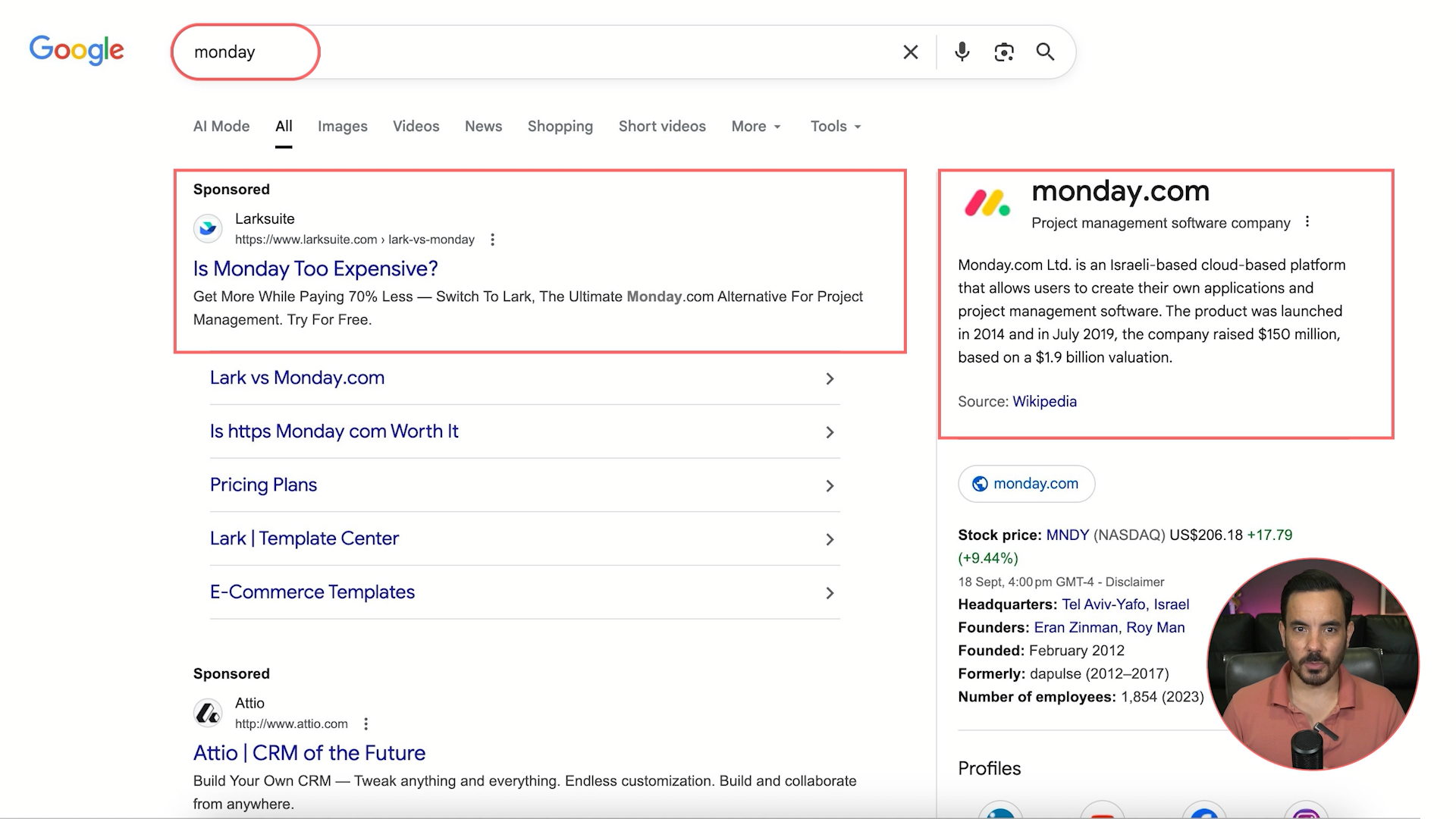
This “Monday.com” example is a classic. Larksuite shows up on the brand query and punches straight at a known objection: price. They frame themselves as the more affordable alternative. That is competitor targeting in a nutshell - show up when a shopper is considering your rival, then make a clearer, stronger offer.
Two compliance rules to keep you out of trouble:
Do not use a trademarked competitor brand term in your ad text. Even if a term is not trademarked, I generally avoid naming competitors in the copy. It keeps your account clean and avoids unnecessary drama.
Do not imply affiliation. Claims like “Official Monday.com Partner” are a fast track to disapprovals unless they are true.
Follow those, and you can legally tap into competitor demand at scale.
The System, Step By Step
Step 1: Research competitors properly
Skipping research is how competitor campaigns become money pits. Do this groundwork and your odds of positive ROAS jump immediately.
Use Auction Insights in Google Ads
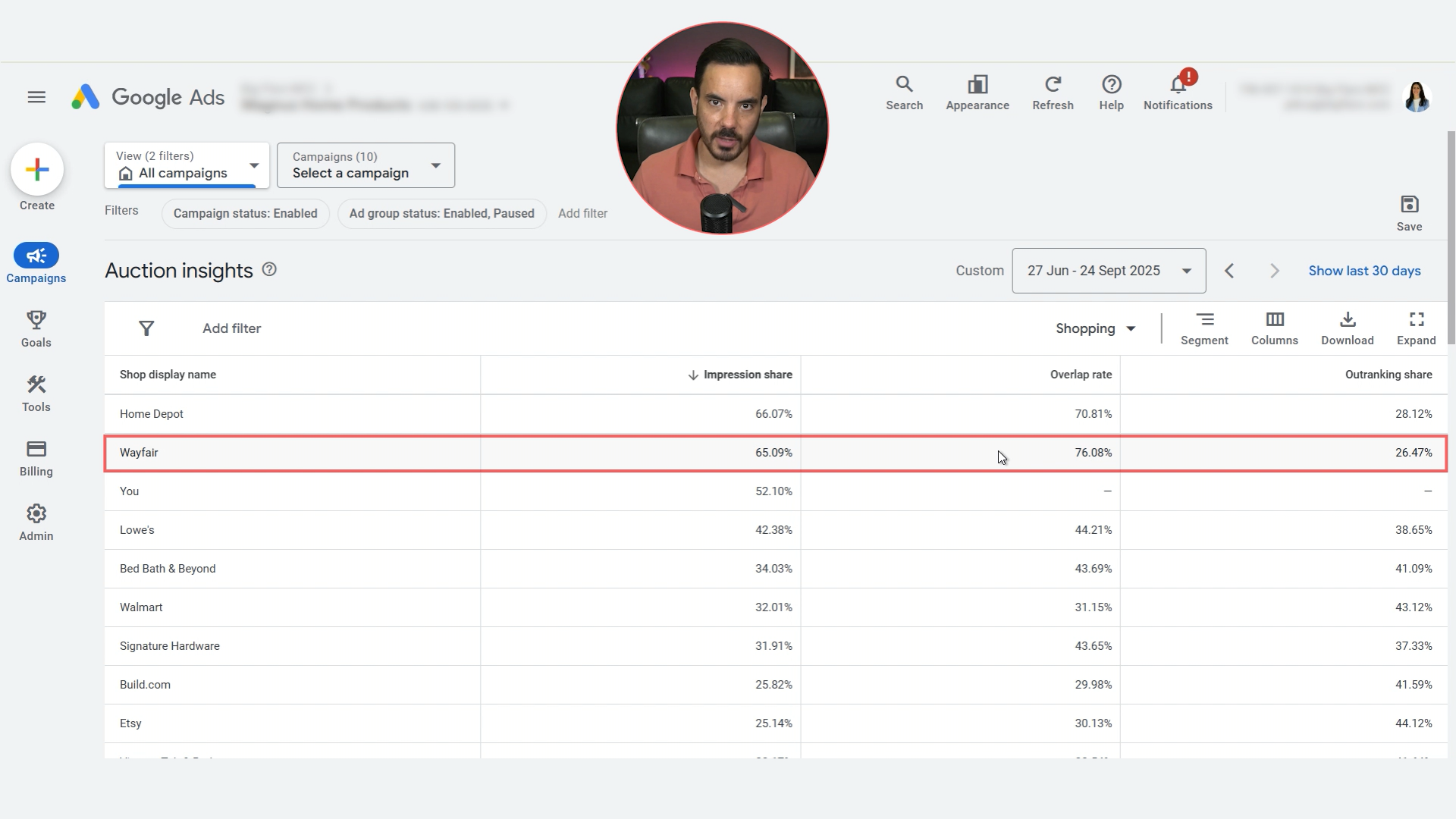
Go to Campaigns - Insights and Reports - Auction Insights. Open up the date range to 90 days to smooth out short term noise. Switch the view to Shopping if you are an ecommerce brand.
Sort by Impression Share to see who truly shows up most often. Brands near your own impression share are the closest rivals. Then examine:
Overlap Rate - how often you and a rival appear in the same auction.
Outranking Share - how often you rank above them or appear when they do not.
If your own impression share is low, it is a signal to improve feed quality, ad relevance, bids, or budget.
Use Keyword Planner to surface real brand demand
Tools - Planning - Keyword Planner - Discover New Keywords. Enter core product terms, then sort by Average monthly searches. Use Refine keywords to filter to Brand only. You will get a clean list of brand names customers actually search for. That is your starting list for targeting and prioritisation.
Spy the creative and offer angles that win
Use the Google Ads Transparency Center from the three-dot menu on a competitor’s ad. Review which creatives they run, how their messaging shifts across formats, and what offers repeat. Then cross check on Meta’s Facebook Ad Library to see which hooks and promises they push in paid social.
The goal is not to copy. The goal is to catalogue gaps. Slow shipping, weak guarantees, no free returns, narrow range, higher prices - whatever they fail to offer becomes your positioning fuel.
Step 2: Build a dedicated Search - Competitors campaign
Create a standalone Search campaign for competitor terms. If you are targeting multiple competitors, use one ad group per competitor so you keep the data clean and the messaging precise.
Target two keyword types:
Exact brand: [Competitor Brand]
Use this when they sell the same products you do and shopper intent is a tight match.Brand plus product: [Competitor Brand] + [Product]
Use this when the competitor sells many categories but you only want traffic for the items you stock. Example: “Bed Bath & Beyond dining table” instead of only “Bed Bath & Beyond”.
Add negative keywords from day one to filter out job seekers, investor queries, store hours, coupon-only searches, and any categories you do not sell. This protects your budget and keeps traffic quality high.
Write ad copy that directly addresses the gaps you found in research. If your competitor has higher prices, slow delivery or no free returns, your ad should spotlight your advantage with proof. Do this without naming the competitor in the ad text. It is cleaner and still highly effective.
Finally, send clicks to a landing page that continues the argument you made in the ad. Best case, build a short, conversion-focused page that:
Restates the core advantage plainly
Shows the hero product or range up front
Adds trust elements relevant to hesitant switchers, like guarantees, shipping speed and reviews
Reinforces the keywords with on-page language to help relevance
If a custom page is not possible, choose the best-fit product or category page that honours the ad’s promise.
Step 3: Guide Performance Max with competitor signals
Search is precise, but you can widen your reach by nudging Performance Max towards competitor audiences.
Create a new PMax asset group and:
Add Search Themes for competitor brand and brand-plus-product queries. You can include up to 50.
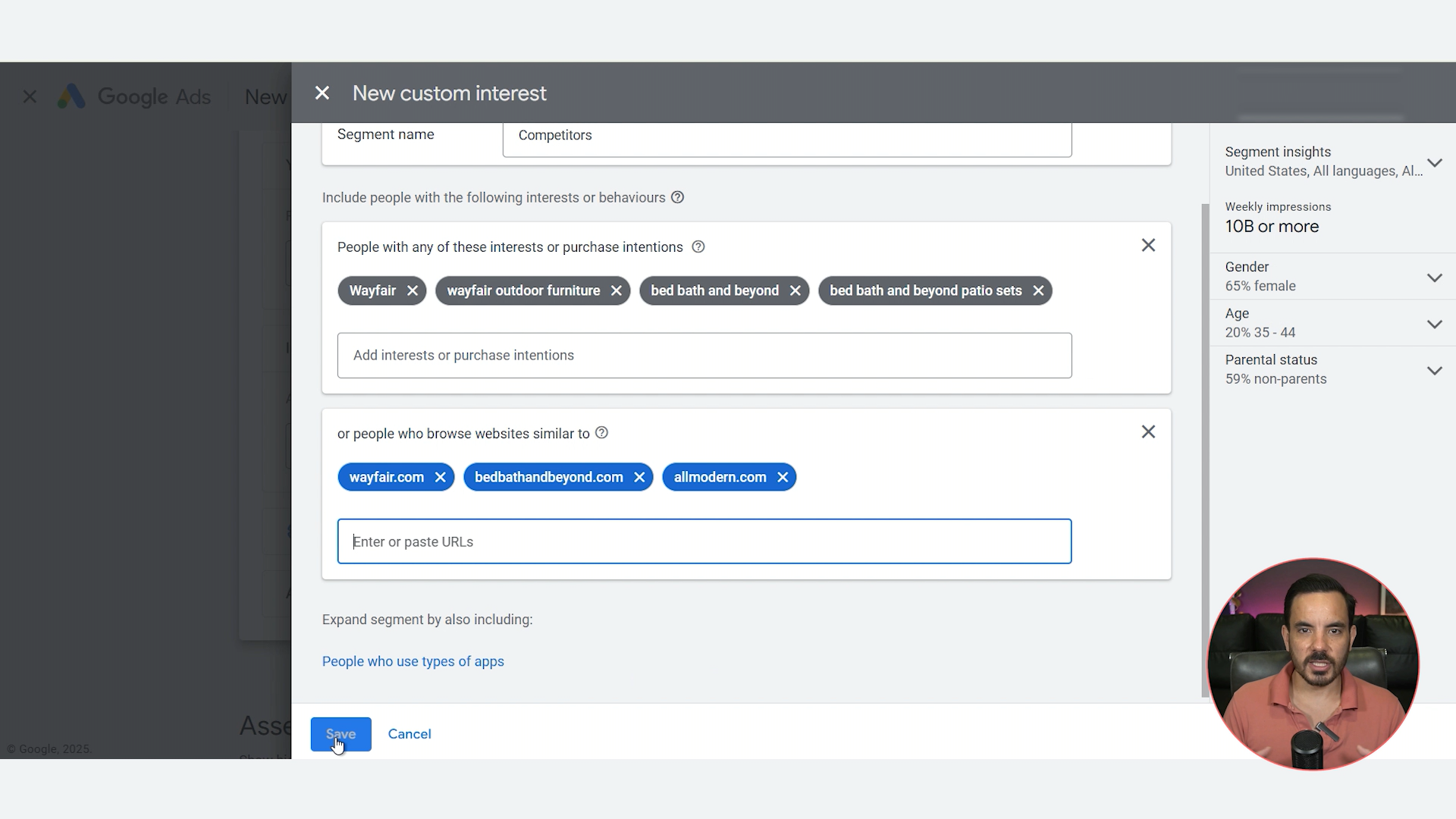
Add Additional signals. Create a new segment named “Competitors”.
In “People with any of these interests or purchase intentions”, include competitor brand names and brand-plus-product phrases that indicate ready-to-buy intent.
In “People who browse websites similar to”, paste competitor URLs.
Important reality check: PMax will never target only your signals. It will expand. Your job is to guide it. Competitor-based signals increase the odds that spend gravitates to people who are actively considering your rivals. Reuse these competitor segments in Display, Demand Gen and YouTube only if you already run those campaign types. Treat them as an additional audience to test, not a reason to create whole new campaigns.
Step 4: Optimise performance like a pro
This is where most brands win or waste.
Start with a controlled budget
Fund the learning phase enough to get meaningful data, but not so much that you burn cash before you have signal. Think of the first 1 to 2 weeks as a structured test.
Track the right metrics at the right time
Early phase: CTR, Conversion rate, CPC. You are validating that you can win clicks at a sane price and convert those clicks on a relevant page.
Once volume stabilises: ROAS becomes the north star. This is the one metric that tells you if you are printing profit or burning cash.
Keep cleaning with negatives
Mine your search terms and add negatives regularly. Daily is ideal for volume accounts. A couple of times per week is fine otherwise. This continuous pruning is how you protect margins.
Test your ads with intent
Run at least two ads per ad group. Rotate headline emphasis, USP, offer and proof. Over time you will learn which angles compel switchers. Keep your best performer, introduce a new challenger, and repeat.
Upgrade your landing page
Make the page feel like the natural next step from the ad. Match the promise, echo the product language, load fast, and place the CTA where shoppers expect it. Add comparison microcopy that strengthens your advantage without naming competitors. Little improvements here produce big jumps in conversion rate.
Improve Quality Score intelligently
You will not get a perfect score when bidding on competitor terms. A 5 or 6 is already strong. Improve it with higher CTR, better ad relevance, and a frictionless landing experience. Even a small lift in Quality Score reduces CPC, which directly increases ROAS.
Scale only after consistency
When ROAS is stable, increase the budget in small steps. A practical rule is no more than 20 percent once per week. Big jumps kick campaigns back into learning and can crater results. Slow and steady wins.
What I Would Do Next If I Were You
Pick one competitor and create a single ad group that targets only them. Use the exact brand and brand-plus-product structure. Launch with two ad variants and a handful of tightly written sitelinks or assets that reinforce your case. Add a short, purpose-built landing page if you can spare a few hours. Then review search terms and add negatives every couple of days. You will learn far more from this focused test than from planning twelve ad groups you never launch.
Practical Examples And Assets To Model
Example advantage messages to test:
Price anchor: “Premium quality at a lower price”
Risk reversal: “30 day free returns and instant refunds”
Speed: “Order by 2pm for next day delivery”
Social proof: “4.8 rating from 3,200 customers”
Negative keyword starters to consider: jobs, careers, investor relations, stock price, contact number, store hours, coupon, voucher, discount code, app download, login.
Landing page sections that convert for switchers: headline that states the advantage, hero product or category, three proof points, comparison microcopy, delivery and returns summary, clear CTA.
What I personally like about this approach
I like competitor targeting because it rewards clarity and courage. If the competitor’s weakness is price, say it and prove it. If your strength is service, put your SLA upfront. If your quality is higher, show the materials and warranty. The strategy works best when you make a specific promise and back it with evidence. That has been my experience again and again.
Conclusion
Competitor targeting works because it intercepts warm, high intent shoppers at the moment they are considering an alternative. Stay compliant by avoiding trademarked names in ad text and never implying affiliation. Do the research first: use Auction Insights to identify true auction rivals, use Keyword Planner to confirm brand demand, and study offers and creatives in the Google Ads Transparency Center and Facebook Ad Library to find exploitable gaps.
Build a dedicated Search - Competitors campaign with one ad group per competitor. Use exact brand and brand-plus-product keywords, add negatives from day one, write copy that highlights your advantages without naming the rival, and send traffic to a page that continues the same argument with speed, clarity and proof.
Guide Performance Max using competitor-focused Search Themes and audience signals so more spend reaches people actively considering your rivals. Then run a disciplined optimisation loop: start with a controlled budget, watch CTR, Conversion rate and CPC early, shift to ROAS as volume stabilises, mine negatives constantly, A/B test ad angles, improve Quality Score to lower CPC, and scale cautiously only after results are consistent.
Start small. Pick one competitor. Launch one focused ad group. Learn, then expand. That is how you legally steal market share with Google Ads.