If you are running Google Ads right now and feel like you have hit a ceiling, like you cannot scale past a certain point no matter what you try, this one is for you.
Most advertisers are stuck at the bottom of the funnel. They are running a Shopping campaign through Performance Max, maybe a branded search campaign, and that is about it. Those campaigns are profitable, but they are not growing. You have probably tried increasing spend and watched your ROAS plummet, or tried broad match and it just wasted your money. The problem is not your campaigns. The problem is you are only using a fraction of what Google can actually do for you in 2026.
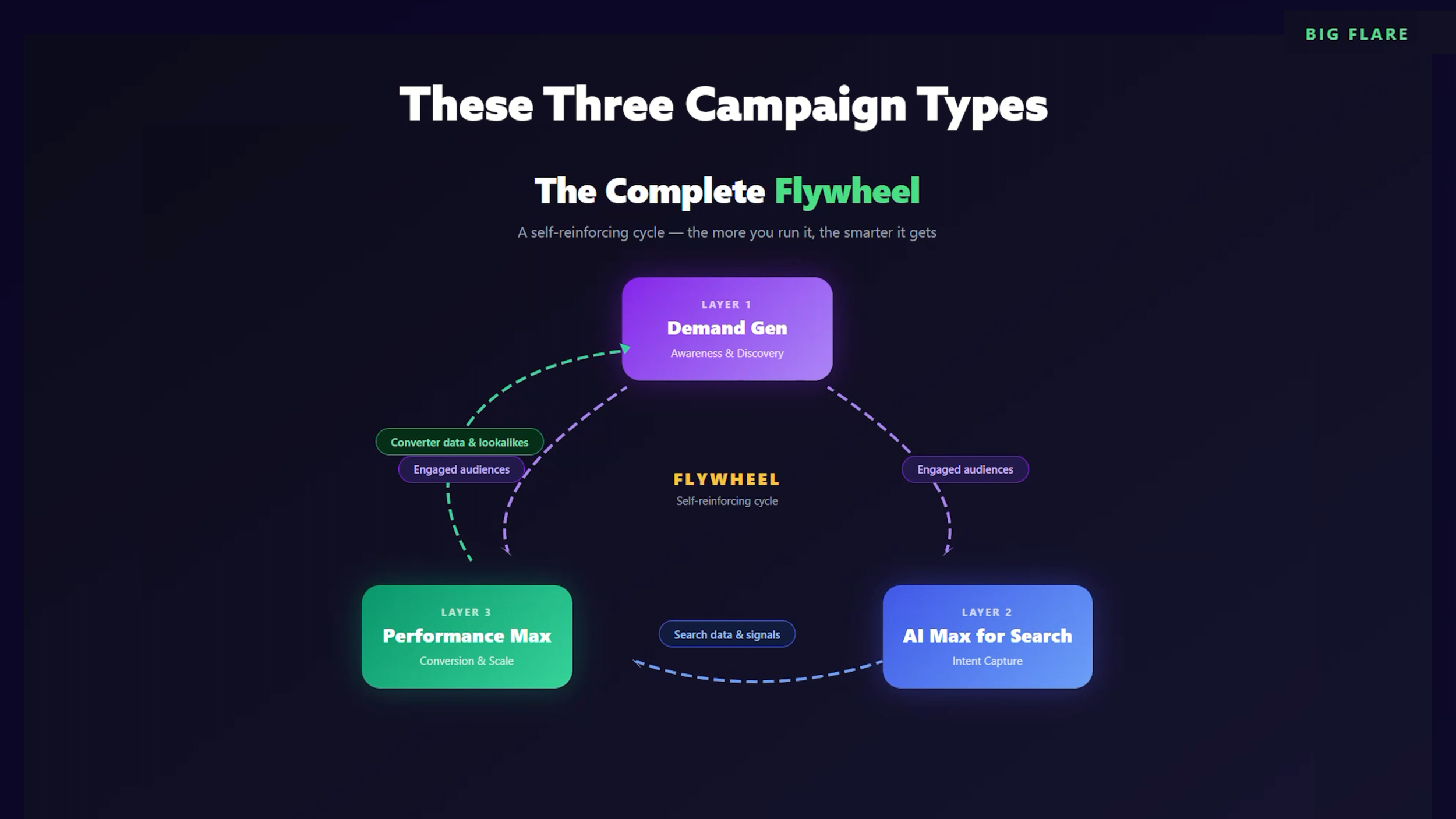
The system I am going to break down uses three campaign types: Demand Gen, AI Max for Search, and Performance Max. Together they form a full-funnel flywheel where data, signals, and learnings are shared across the entire system instead of being locked inside individual campaigns. Google's own teams have started calling this approach the "power pack" at industry events. This is where the platform is heading.
The Three Layers
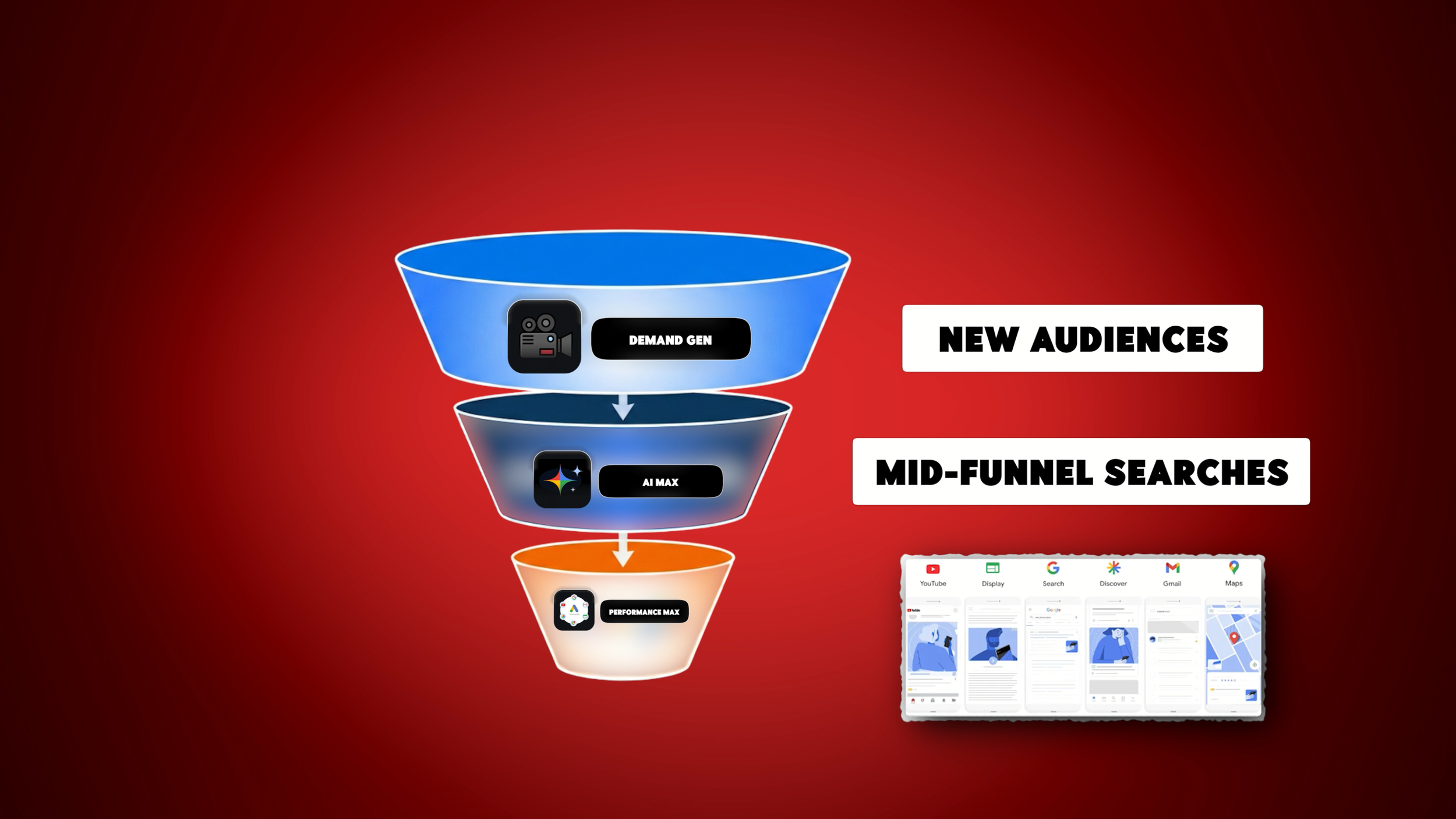
Demand Gen is your awareness and discovery layer. It runs across YouTube, YouTube Shorts, Gmail, and Discover, finding new people who have never heard of you. If you have ever run Meta Ads, this will feel familiar; Google designed it to compete directly with Meta's ad platform. Within the flywheel, Demand Gen builds brand awareness at scale and creates audience pools that your other campaigns use. When someone watches your YouTube ad or engages with your Discover ad, that person becomes a warmer audience. Those engaged audiences feed directly into your AI Max and PMax campaigns through audience signals. Demand Gen is not just top-of-funnel impressions; it is the engine that fuels the entire system.
AI Max for Search is your intent capture layer. After someone sees your Demand Gen ad, they may search for something related days later. AI Max is there waiting. It is Google's AI-powered version of search campaigns: you provide keywords and landing pages, and Google automatically expands your reach to relevant searches you might not have thought of. If you bid on "organic face cream," AI Max might also show your ad for "natural skin care for sensitive skin" because it understands the intent is similar. It also matches ads to the most relevant landing page and generates ad copy variations based on guidelines you set.
Without AI Max in the middle, you are relying on PMax alone to handle search traffic. While PMax does run on search, you have very limited control. AI Max provides a dedicated search layer with more control over keywords, ad copy, and landing pages.
Performance Max is your conversion and capture layer. PMax runs across every Google property and its primary job here is converting people who are ready to buy. When PMax operates as a standalone campaign, it tends to harvest existing demand. As part of the flywheel, it behaves differently: Demand Gen fills the top with new audiences, AI Max captures mid-funnel searches, and PMax converts warm and hot audiences at scale instead of just recycling existing customers.
How the Flywheel Connects
This is where most people fail. They set up all three campaign types and run them independently, not sharing data, competing against each other. That is not a system; that is campaigns sitting in silos.
Here is how you connect them. Demand Gen runs creative to cold audiences. People who engage become trackable audiences. You feed those audiences as signals into AI Max and PMax, telling Google: these are the types of people interested in my brand, find more like them.
But this is not a one-way street. PMax generates conversion data from real buyers. That data builds customer match lists and lookalike seeds that feed back into Demand Gen. So now Demand Gen targets new people who look like your actual buyers, generating better engaged audiences, which feed better signals into AI Max and PMax, which produce even better conversion data. It is a self-reinforcing flywheel that becomes smarter the longer you run it.
Key Tips for Each Layer
Demand Gen
Separate cold traffic and retargeting into different campaigns. If you mix them, Google will spend all your budget on retargeting because those people are easiest to convert.
Turn off Google Display Network. YouTube, Discover, and Gmail are Google-owned surfaces that perform well. GDN is a network of external websites and tends to underperform significantly.
Use video creative. A lot of Demand Gen's performance comes from YouTube and YouTube Shorts placements. If you already have videos working in Meta Ads, use those same videos here.
Build lookalike audiences from your customer list, and separately from your high-value customers.
Start on Maximise Conversions with no target for the first 30-50 conversions, then test Target CPA or Target ROAS. Sometimes staying on Maximise Conversions actually performs better, so treat this as a test.
AI Max for Search
Use text guidelines. This feature lets you instruct Google in natural language about what your ads should and should not say, like "never use the word cheap" or "always position products as premium." This is how you control AI-generated ad copy.
Feed in Demand Gen audiences as signals to connect the two campaigns.
Add brand keywords as negatives. Run a separate branded search campaign. Without brand negatives, AI Max will eat into your brand traffic and make its performance look better than it actually is.
Transition to Target CPA or ROAS after 30-50 conversions. Unlike Demand Gen, having a target reliably works better for AI Max, so add one as soon as you have enough data.
Performance Max
Segment by product category or margin tier. Use custom labels in your product feed to group products by margin so you can bid aggressively on your highest-margin products.
Feed in audience signals from both Demand Gen and AI Max. This is the final connection point that turns three campaigns into one system.
Check channel performance reports regularly. This report breaks out ROAS and CPA by channel and by product feed versus non-feed ads, showing you exactly where PMax is spending your money.
The Budget Split
For a new system, I recommend: 60% PMax, 25% AI Max, 15% Demand Gen. This keeps the majority on the campaign most likely to produce immediate returns.
For a mature system (90+ days, hundreds or ideally thousands of conversions): shift towards 50% PMax, 25% AI Max, 25% Demand Gen.
For aggressive growth: push Demand Gen up to 30%, but only if you have the budget headroom and are comfortable with a longer payback period.
Minimum budget: I recommend at least $10,000 per month for this system to work properly. Below that, focus on PMax and Search alone until you can afford to add Demand Gen. The algorithms need enough data across all three campaign types; spread a tiny budget too thin and the whole system underperforms.
Common Mistakes
Not connecting audience signals between campaigns. Without these connections, you just have three isolated campaigns that happen to share an account.
Going too heavy on Demand Gen too early. Establish your PMax and AI Max foundation first. If you shift too much budget before bottom-of-funnel campaigns are stable, your account ROAS will tank and you will panic.
Judging Demand Gen on last-click ROAS. It is a top-of-funnel campaign; it is not supposed to produce direct last-click conversions at scale. Instead, look at overall account revenue, branded search volume, and whether AI Max and PMax are seeing more conversions. Use data-driven attribution so Demand Gen receives partial credit for assists. And check the "platform comparable conversions" column in Google Ads, which shows a bigger picture of all conversions Demand Gen has helped produce, comparable to how Meta tracks conversions.
Running Demand Gen with only image ads. Image-only creative pushes you into the Google Display Network, typically the lowest-performing placement. Use video ads, landscape and portrait-formats, to place your ads on YouTube and YouTube Shorts where the high-quality impressions live.
Conclusion
The flywheel system uses three campaign types: Demand Gen at the top for awareness, AI Max for Search in the middle for intent capture, and Performance Max at the bottom for conversion and capture. The real power is in how they connect, sharing signals and feeding data into each other so the whole system becomes smarter over time.
Key takeaways:
Build a full-funnel system using Demand Gen, AI Max for Search, and Performance Max as a connected flywheel, not isolated campaigns.
Connect them by feeding Demand Gen engaged audiences as signals into AI Max and PMax, and feeding PMax conversion data back into Demand Gen as lookalike seeds.
Start with a 60/25/15 budget split (PMax/AI Max/Demand Gen) and shift towards 50/25/25 as the system matures.
Separate cold traffic and retargeting in Demand Gen; turn off Google Display Network; invest in video creative.
Use text guidelines in AI Max to control ad copy; add brand keywords as negatives.
Segment PMax by product category or margin; check channel performance reports to understand where your budget is going.
Do not judge Demand Gen on last-click ROAS; use data-driven attribution and platform comparable conversions instead.
Plan for a minimum of $10,000/month total spend for the system to have enough data across all three campaign types.