
If you're trying to decide whether to put your ecommerce advertising budget into Meta Ads or Google Ads, I need you to understand something first.
This isn't just a platform choice.
This is a strategic decision that will shape your entire revenue trajectory for the next twelve months and beyond.
After 17 years in this industry and having generated over $150M in ecommerce revenue through Google Ads alone, plus extensive experience running Meta campaigns, I've developed a framework that makes this decision crystal clear.
The Demand Generation vs Demand Capture Framework
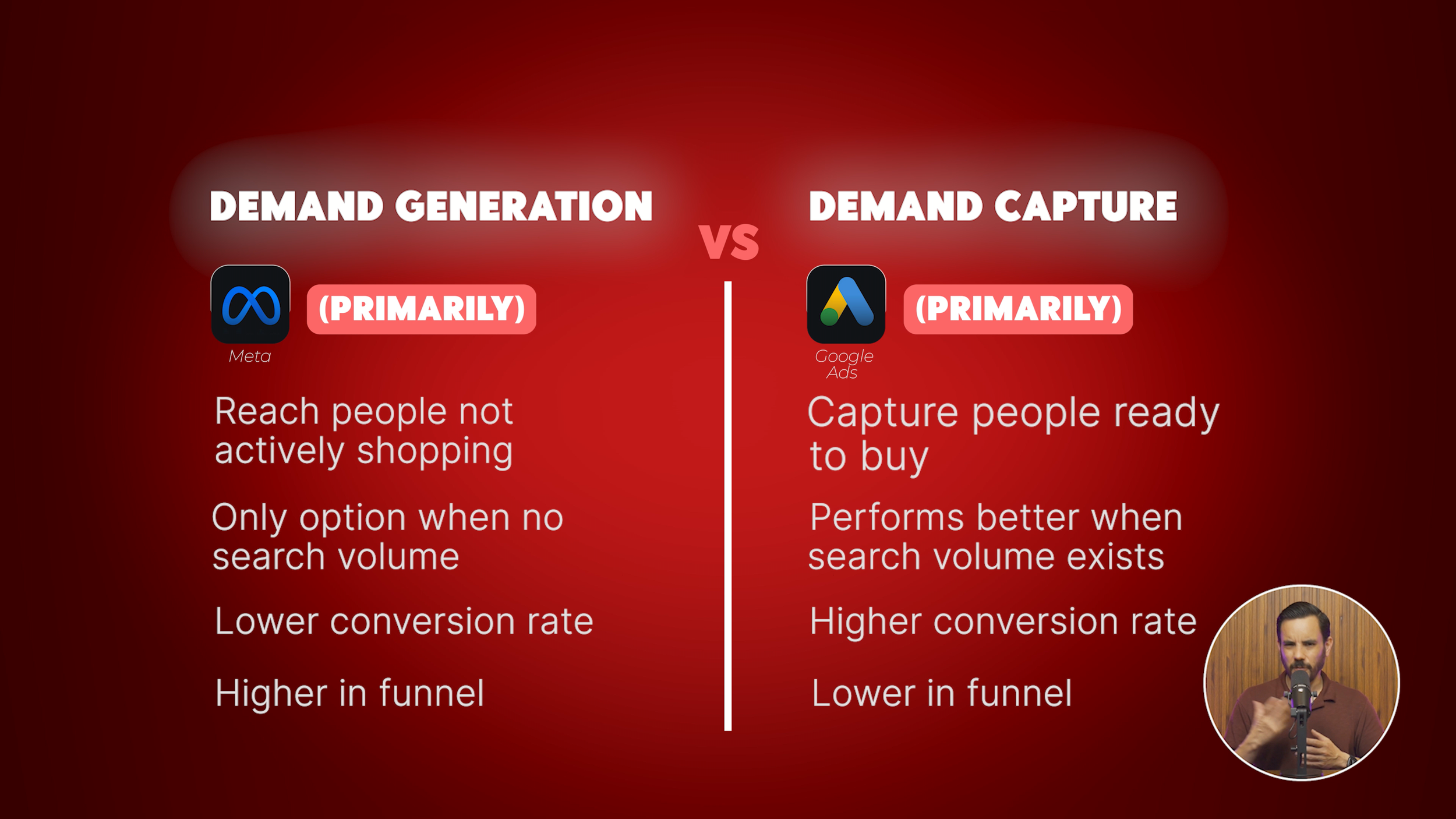
This is the single most important concept you need to understand. Once it clicks, everything else falls into place.
Demand Generation is about creating desire for products that people don't know they need yet. It's top-of-funnel advertising. You're targeting people who might be problem-aware, but they're not solution-aware.
Here's an example. Someone is scrolling Instagram. Their back has been hurting lately. They know they have a problem, but they haven't actively started looking for solutions. Then your ad pops up showing a posture-correcting back brace that could solve their issue. Before they saw your ad, they didn't know this product category existed. Your ad created the demand.
Demand Capture is the opposite. It's about capturing existing demand. It's bottom-of-funnel advertising, targeting people who are both problem-aware AND solution-aware. They already know what they want and they're actively looking to buy it. Someone goes to Google and types "posture correcting back brace." They just need to find the right one to purchase.
Here's the key insight: Meta equals Demand Generation. Google equals Demand Capture. At least primarily.
If sufficient search volume already exists for your product, Demand Capture often performs better because these people are closer to the purchase decision, with higher conversion rates and warmer audiences. If no search volume exists because your product is too new or too novel, then Demand Generation is your only option. You have to create the demand before you can capture it.
When to Choose Meta Ads
Meta should be your primary platform in three key scenarios.
Novel Products Without Search Volume
These are products that solve problems people have, but they don't know the solution exists yet. Think new innovative gadgets, unique solutions to common problems, and products that need to be explained. If people don't know your product category exists, they can't search for it on Google. You need to put your product in front of them and show them why they need it. That's Meta's wheelhouse.
Problem-Aware But Not Solution-Aware Audiences
Going back to the back pain example. Someone knows their back hurts, but they haven't started searching for "posture correcting back brace" because they don't know that's a thing. Meta can deduce from their behaviour that they likely have back problems. Maybe they follow fitness pages, they've engaged with content about sitting at a desk all day, or they've shown interest in ergonomic products. Facebook's algorithm can piece together these signals and put your solution in front of people experiencing the problem before they even start searching. That's incredibly powerful.
Strong Creative Production Capabilities
This one is really important and a lot of people overlook it. Meta is a creative-driven platform. You need high-quality images and videos, you need to refresh your creative regularly because creative fatigue is real, and you need multiple variations for testing. If you have the resources to invest in photography, videography, or high-quality stock assets, then Meta becomes much more viable. If you don't have those resources, Meta will be an uphill battle.
Meta's core strengths come down to two things. First, the audience data and targeting algorithm. Facebook has an incredible amount of data about its users. The algorithm can place your solution in front of people who are experiencing the problem you solve, even if they're not actively searching for a solution. Sometimes, the algorithm might even know they have a particular problem before they do. Second, the ad format advantages. Meta's ads take up most of the mobile screen, they're integrated into the feed so they feel native, and you have full-screen Stories and Reels formats. Unlike display banner ads where users have developed "banner blindness," Meta ads actually capture attention.
When to Choose Google Ads
Google should be your primary platform when:
Existing Search Volume for Your Product
People are actively searching for your product category. Think running shoes, office chairs, protein powder, yoga mats. You can verify this using Google Keyword Planner. Just type in your product category and see what kind of search volume exists. If you're seeing tens or hundreds of thousands of monthly searches, then that's a great volume of demand to capture.
Precise Control Over Targeting
With keyword targeting, you decide exactly what searches trigger your ads. The users themselves are telling you what they want to buy right now, so you're not relying on an algorithm to interpret who might be interested. You capture high-intent buyers who are actively looking to purchase.
Limited Creative Production Resources
This is a big one. Google has a much lower barrier to entry when it comes to creative. For Search campaigns, you just need text: fifteen headlines, four descriptions, and you're good to go. For Shopping ads, you just need your product feed. No custom creative production required. This makes Google much faster to launch and test than Meta. You can be up and running in a day without any creative production.
Performance Expectations: Volume vs ROAS
This is where a lot of people become confused, and it's worth understanding the trade-offs.
ROAS is typically much higher on Google than on Meta. I typically see Meta ROAS of 200-400% for well-optimised accounts, while Google ROAS of 300-600% or even higher is achievable. The difference comes down to funnel position: bottom-of-funnel traffic converts better than top-of-funnel traffic.
Volume is where Meta has a massive advantage. Meta typically drives four to five times more spend capacity than Google when fully built out. I see this with clients all the time. They might be spending $100,000 per month on Meta, but only $20,000-$25,000 per month on Google. Search volume is limited by existing demand. You can only capture what people are already searching for. Meta's audience is nearly limitless by comparison.
So here's the summary: Meta equals volume and revenue growth. Google equals maximum ROAS and efficiency.
A Real Client Example
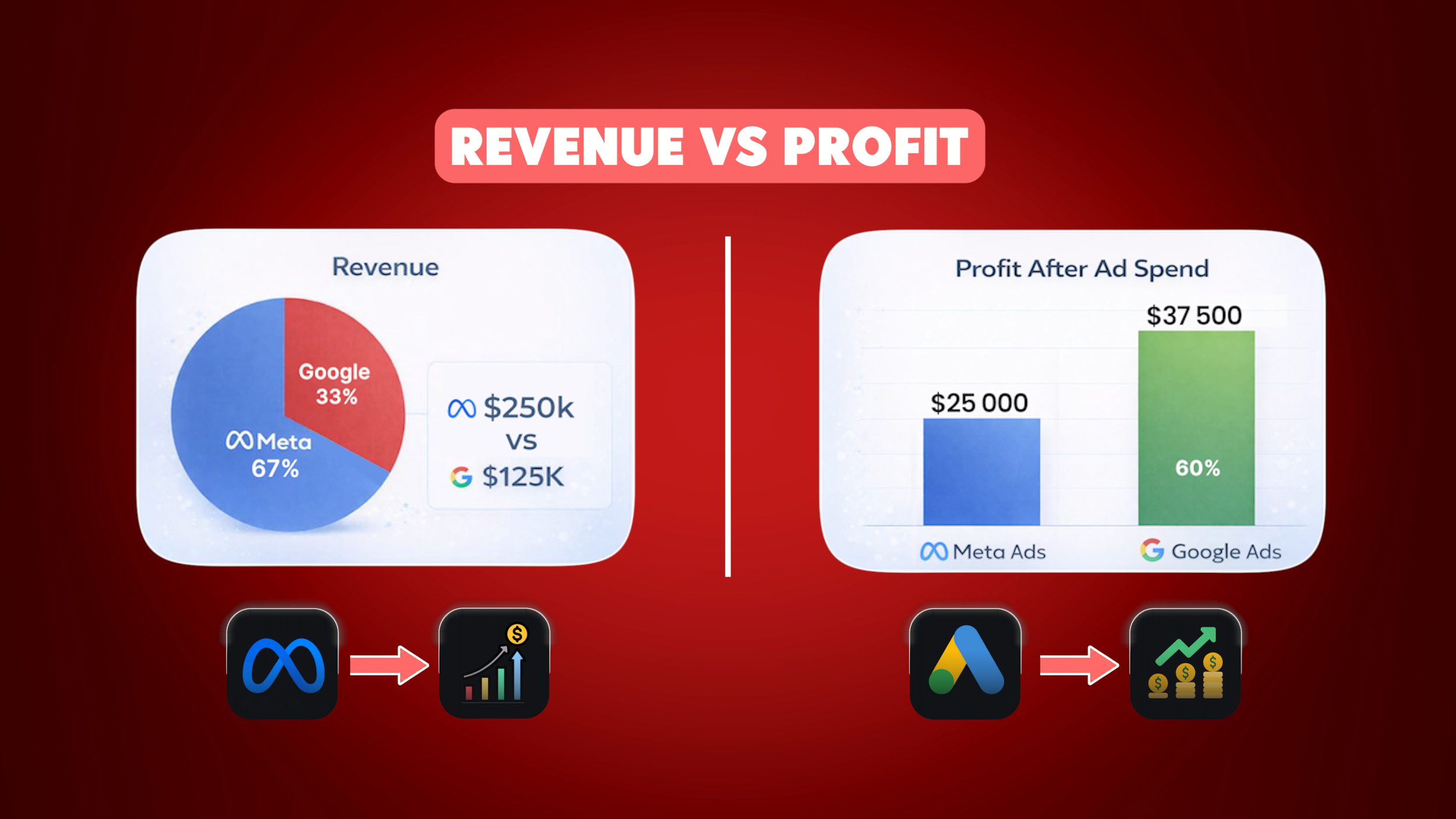
Let me show you a real client example that illustrates this perfectly. These numbers are from a real ecommerce client spending $125,000 per month combined across both platforms, with a 50% gross profit margin.
Meta performance: $100,000 per month in spend at 250% ROAS, generating $250,000 in revenue. With a 50% gross margin, that's $125,000 in gross profit. After subtracting the $100,000 in ad spend, they're left with $25,000 in profit after ad spend.
Google performance: $25,000 per month in spend at 500% ROAS, generating $125,000 in revenue. With a 50% gross margin, that's $62,500 in gross profit. After subtracting the $25,000 in ad spend, they're left with $37,500 in profit after ad spend.
Here's the interesting insight. Meta drives 67% of their total revenue ($250,000 vs $125,000). But Google generates 60% more profit after ad spend ($37,500 vs $25,000). Meta is the bigger revenue channel; Google is the higher profit channel.
This is exactly why you need both platforms working together. Meta for scale and growth, Google for profitability and efficiency. Google's profit would be lower if we weren't generating demand and search volumes using Meta Ads. And if we only did Meta Ads, we'd have much lower total profit and efficiency.
Running Both Platforms Together
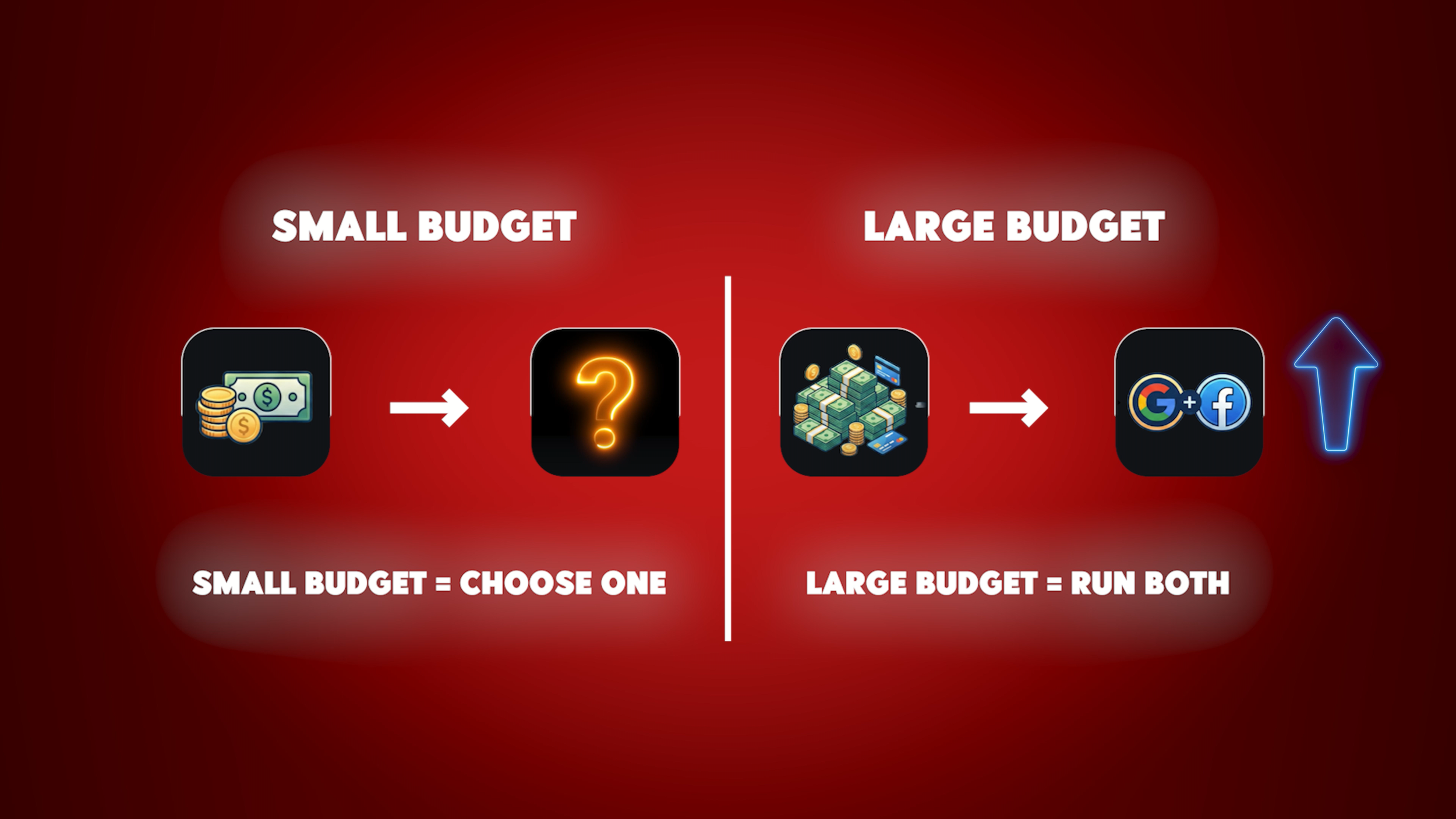
If your budget allows $30,000 per month or more in total ad spend, I strongly recommend running both platforms together.
This is where you capture the best of both worlds: volume from Meta, high ROAS from Google, and maximum total revenue and profit.
Here's how the synergy works.
Meta creates awareness and consideration. Potential customers see your brand and learn about your product, but they don't always buy immediately because it's cold traffic. Later, when they are ready to buy, they search on Google for your brand name or product category. Google captures the intent that Meta created.
The result: more total conversions than either platform could generate alone.
There's also the halo effect. Meta drives branded search volume on Google. The more people see your Meta ads, the more they search for your brand name later. Google retargeting can capture Meta traffic that didn't convert initially. And brand awareness from Meta actually increases Google conversion rates.
For strategic allocation, if you have established search volume, start with Google first. It's easier, faster to see ROI, and gives you a foundation of profitable sales. Once Google is profitable, add Meta to scale beyond the limits of search volume. Alternatively, if no search volume exists, start with Meta. Create the demand first, then add Google once you've scaled out some volume and there's more demand to capture.
As a budget allocation example for someone spending $50,000 per month: for an established brand with strong search volume, try 60% Google and 40% Meta. For a new product with limited search volume, try 70% Meta and 30% Google. Adjust based on what's working and your business goals.
Common Mistakes to Avoid
Before wrapping up, here are the most common mistakes I see people make.
Running Meta with weak creative. Meta is a creative-driven platform. Poor creative equals wasted spend, regardless of how good your strategy is. If your creative doesn't stop the scroll, nothing else matters. Invest in creative before you scale your Meta spend.
Expecting Google-level ROAS from Meta. Someone runs Meta, achieves a 250% ROAS, and thinks it's underperforming because their Google campaigns do 500%. But they're different funnel stages with different performance expectations. Compare each platform to its own benchmarks, not to each other.
Ignoring one platform when you could afford both. If you have the budget to run both platforms but you're only running one, you're leaving revenue on the table and capping your growth potential unnecessarily.
Not giving Meta enough time or budget to learn. Meta's algorithm needs volume and time to optimise. If you spend $200, receive poor results, and turn it off, you've given up too early. Commit to at least 30-50 conversions before judging Meta performance. Premature judgement kills potentially profitable campaigns.
Conclusion
The Meta vs Google decision ultimately comes down to the Demand Generation vs Demand Capture framework. Meta excels at creating desire for products people don't know they need yet, while Google captures existing intent from people ready to buy. Meta delivers volume and revenue growth; Google delivers higher ROAS and efficiency. For smaller budgets under $15,000 per month, choose the platform that best matches your product type, creative resources, and existing search volume. For budgets above $30,000 per month, strongly consider running both to capture the synergistic halo effect where Meta-driven awareness fuels Google conversions, and the total result is greater than the sum of its parts. The ultimate goal is always to scale to the point where you're running both platforms together.